Happy Retirement? Not Yet.

Happy Retirement Card

The shelf above my entertainment center could barely contain all the thoughtful retirement cards given to me by co-workers, family, and friends.  Each one celebrated my achievement of 41 years of full-time work and painted the next chapter of my life to be nothing but positive.  One card’s cover said, “Happy Retirement!”  The inside asked, “Is there any other kind?”   After my first month and a half of retirement, I can say, YES, there is.

No one tells you in the period leading up to retirement that there can be difficult and dark moments after leaving a career, especially if you loved your job and workplace, like I did.  My coworkers only lauded the perceived advantages of retirement, some expressing wistful envy that they couldn’t join me.  Even the retirees I spoke to prior to ending employment painted a rosy picture of a “liberated” phase of life, telling me that I was going to love it.

And they weren’t completely wrong.  My body and mind are grateful to approach my days with a relaxed pace, rather than pushing myself to the brink physically and mentally to meet the stressful demands of work.  I have been exercising regularly, something I never found time to do while employed.  I’ve had more time to connect with my church community, spend time with old friends, and explore new friendships.  I’ve started reading for pleasure again, something I never wanted to do after staring at a work computer all day.  And this blog post is the first time I’ve been inspired to write non-work content in many years, perhaps an indication that the writer in me is reawakening. All great things!

BUT.  

The major life transition of going from sixteen years of meaningful work with my final employer to staring at a still mostly empty calendar also brings struggles that are anything but happy.  

My retirement ushered in a season of deep grief and isolation, compounded by living alone.  I am grieving the loss of purpose and belonging that my job provided.  Most of all, I miss the daily connections with cherished coworkers with whom I shared both work and life.  I have cried as heavily as I did after other major life losses, including the death of loved ones.  Even though I still feel welcomed and appreciated when I enter my former workspace, I am acutely aware that I am no longer an insider and they have moved on without me.

I’ve been quite transparent with friends, family, and co-workers about my struggles during this transition.  Many people have been kind and supportive, but I’ve also sensed an awkward discomfort from those who simply can’t fathom that retirement could be anything but happy.  When they check in a few weeks later and I’m still struggling, they seem even more uncomfortable, giving the subtle impression that I should be “over it” by now.  The high achiever part of me is tempted to agree with them and put pressure on myself to figure it out, which only makes things worse.

The one group of people who seems to “get it,” however, are retirees.  While I was still working, all they talked about was how great retirement would be.  But when I pull them aside now and tell them how I’m struggling, a veil comes down and many quietly reveal they went through similarly painful transitions.  For some, it took many months—even years, to find a new rhythm, purpose, and joy in their retired season.  But most have gotten there—and that gives me hope. 

The grief and loneliness I feel as a new retiree are real – and it is an uncomfortable space to live in.  However, I have faith that my sadness will eventually be replaced with fresh purpose and belonging. I’m learning that the more I let go of past life patterns, the more capacity I have to receive new things. One of my prayers has been, “Help my heart to be open to all You have for me.”

In this time of waiting, healing, and discovery, the most important thing I can do is to keep trusting God, each step of the way.  As one of my favorite scripture verses says, “Trust in the Lord with all your heart, and lean not unto your own understanding.  In all your ways acknowledge him, and he will make your paths straight.”

One-year reflections of a grieving daughter

Last Thanksgiving, instead of gathering with loved ones to enjoy a feast, I huddled alone in front of my laptop, tears streaming down my face.  My father had died just two days earlier, and I spent the holiday planning his funeral.

While I felt the intense void of dad’s absence this Thanksgiving, I also experienced gratitude for the progress I’ve made in my grief-journey.

Here are eleven things I learned about grieving during this past year:

1. Grieving can begin while a loved one is still alive. I began feeling the deep ache of losing my father long before he died.  This is called “anticipatory grief.”   Some end-of-life journeys are very long good-byes.  As our loved one declines, we not only grieve incremental losses of  physical and mental abilities, we begin to pre-grieve losing him or her completely.

1205151138a-2

2.  Everyone expresses grief differently. I didn’t cry at my dad’s funeral, even when I gave a tribute.  What people never saw were the countless times I privately wept from the depths of my soul.  It’s important to remember that outward appearances may not tell the whole story.  A person who looks like they “have it all together” may be falling apart on the inside.  On the flip side, individuals who freely let their emotions show may not be as fragile as they appear.

3.  Grief doesn’t follow a timeline. The “five stages of grief,” (denial and isolation, anger, bargaining, depression and acceptance) [1] are interpreted by some to mean that once we check off the final box, we are done mourning.  In reality, grieving does not follow a predictable path, nor is it something we “finish.” Major loss changes us forever—and it should.  To put pressure on ourselves or others to “just get over it and move on” is both unkind and unrealistic.

4.  Grief hinders life functioning. I became frustrated during my first few weeks back at work because I made many more errors than usual.  Later I was reminded that a grieving person’s body, brain, and emotions are in a compromised state, making it harder to focus and think critically.  In fact, several grief recovery resources state that it’s wise to avoid making any major life decisions for at least six months following a significant loss. [2]

5.  It gets easier. Really, it does.  Recently I’ve been following the grief-journey of a man who lost his wife to cancer.  His sorrow is so profound that he cannot fathom ever feeling better.  I used to feel the same way.  But one day, at about the 3-month mark, I noticed I could sometimes make it through the day without crying.  My grief “symptoms” gradually lessened from that point on. While everyone progresses at a different rate, it does get easier. Continue reading

God is Good . . . some of the time?

sacred-datura-flower-from-anza-borrego-desert-725x544[1]

I stood wearily outside the mortuary, listening to the elderly woman share about her husband’s recent passing.

“We were on our way to visit family. He just got into the car, closed his eyes and he was gone!” She went on to describe how it was such a blessing that he went so fast and painlessly, exclaiming, “God is so good!”

My father had passed away just two days before her husband, and his death was long and drawn-out. All I could say in return was, “it didn’t work out that way for my dad.”

Since that encounter, I’ve been more aware of when people use the phrase, “God is good.” And I’ve noticed that they typically say it when something positive has happened.

God answered a prayer the way they wanted it.

God healed someone.

God provided something they needed.

God made something easier.

Which begs the question: Is God only good when life is good? In other words, is God only good – some of the time? Continue reading

Saying Farewell to Mom and Dad’s House

My co-worker and I were discussing plans for spring break from the college where we work.  “I’m going home,” she declared.  I knew this meant she would be traveling to visit her mom and dad several thousand miles away.   Though married and middle-aged, home was still where her parents lived.

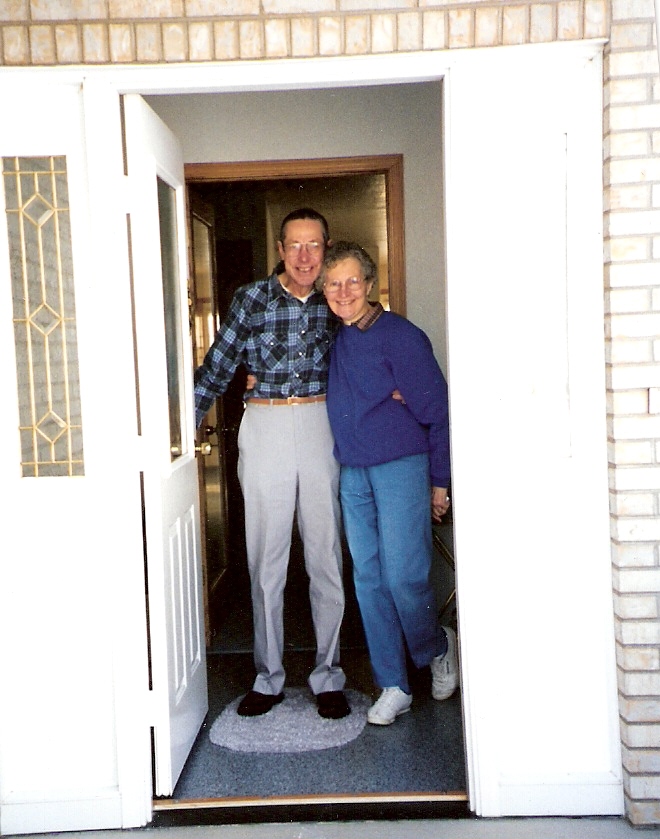
Mom and Dad at door

Dad and Mom

I could relate.  The places where my mom and dad resided always represented “home” to me, no matter what my age.  Their house possessed an irresistible magnetic force, especially during the holidays.  It was where I could drop in anytime, be warmly welcomed, and stay as long as I wanted.  Mom and Dad’s home represented familiarity, comfort, love, and security.  It was my soft place to land.

Even after mom passed away eight years ago, dad remained living in their house, so it continued to serve as a central gathering place for our family.  For years I dreaded the day when dad would no longer be able to live there and my brothers and I would be faced with dissolving his estate.  Though I knew it was inevitable, the thought overwhelmed me—not only because of the magnitude of the task, but because it would mean losing my home base.

This past fall that time sadly arrived for our family.  After our dad’s health turned, we were faced with disassembling his home filled with a lifetime of memories. Continue reading

Faced with a Life or Death Decision

A flood of fresh tears flowed as I thumbed through the twenty-eight page  document.  The Medicare “Summary Notice” coldly spelled out the amounts paid to the mile-long list of medical providers.   I couldn’t help but re-live the experience of dad’s final days as I moved chronologically through the papers.  The final ER visit.  Multiple blood draws.  An electrocardiogram.  Numerous ex-rays and a CT scan.  The chest tap and chest tube. The ambulance ride back to the nursing home.  The physician’s final visits.

Perhaps what stood out most was the ER doctor’s description: “Emergency department visit, problem with significant threat to life or function.”

ER signDad was, indeed, gravely ill when he landed in the emergency room in mid-November.  His white blood-cell count was sky-high, indicating something was seriously wrong.  When I arrived at his bedside, I couldn’t help but look at his frail body and think that we might not be there had it not been for a snap decision made by a physician a month earlier. Continue reading